- +91 8976402918
- connect@venonto.com

Terrace Garden Setup in Hyderabad: A Simple, Practical Guide for Homeowners

If you live in Hyderabad, you have probably at some point looked at your rooftop and thought, “This place is just lying idle.” Can’t it be something else?
- Maybe you want to grow clean food
- Maybe you’d want a greener home.
- Maybe you’re simply fed up with purchasing veggies that don’t taste like vegetables.
You’re not alone! For this reason, an increasing number of families in Hyderabad are choosing terrace gardening as a way to improve their lifestyle rather than as a hobby.
In a study on urban terrace gardening, over 90% of participants reported improved emotional well-being, while nearly 70% said it helped them make productive use of previously unused rooftop space. (Source: International Journal of Environment & Climate Change)
Regardless of whether you live in a villa, an independent home, or have access to a shared outdoor area. You can definitely turn your vacant concrete area into a thriving green space.
Let us walk you through what actually works, devoid of technical terms, irrational claims, and needless complexities.
Why Hyderabad Homes Should Have Terrace Gardens
Starting a terrace garden is more feasible than you imagine, especially in Hyderabad. Many residences already have one along with the right conditions without going for a major change.
Why? Because this city provides you with three significant advantages:
- Sunlight is available almost the whole year: Your greatest resource is sunlight. The city has enough sunshine, which is exactly what plants need to thrive, unlike colder climates, where planting is seasonal.
- The weather is favorable: Hyderabad’s environment naturally supports a range of vegetables, leafy greens, and herbs without the need for artificial climate control or greenhouses. Everything that grows here flourishes.
- Your terrace is wasted space right now: Most houses have flat, open terraces that are either neglected or used as storage. That same area can very well be converted into a small garden that provides your family with fresh, homegrown vegetables.
This unique combination makes a home terrace gardening setup not only feasible but also quite useful.
And here is what you don’t need: daily labor, a large budget, or farming experience.
All you need is careful planning.
What Actually Works for a Home Terrace Garden Setup
Let’s be honest, you are not trying to manage a farm. You have a life outside of gardening, a family, and a job. Growing anything under the sun is not the key to a great home terrace garden. It’s about growing what comes naturally to you daily.
The setups that actually last for long along with that you can balance work and family time.
- It doesn’t require ongoing care. When you leave for a week, you won’t have to bother about watering; it’s all about low-maintenance systems.
- You cultivate herbs and vegetables that you actually use. Items that are a part of your everyday meals include spinach, tomatoes, chilies, and coriander.
- You can start small and expand when ready. Begin with 10-15 pots.
That’s the difference between a terrace garden that grows alongside you and one that just sits there for a few months and gets forgotten. When gardening feels easy and gives you joy, you naturally keep going. When it feels tiring or stressful, it slowly gets left behind.
Is Your Terrace Ready for a Garden?
Start with a Simple Terrace Check
Before any installation, just check a few basics:
Is the waterproofing in good condition?
During the day, does the area receive sufficient sunlight?
Does excess water have proper drainage?
Can pots and planters/beds be placed safely?
These small checks save you from seepage problems and plant losses. Every successful home terrace garden in Hyderabad starts with getting these basics right.


2. Layout: Keep It Practical
A good layout helps you:
- Use space efficiently: Plants are arranged in such a way that you are really using the space you have, not just filling it randomly.
- Walk comfortably between plants: You need to have a clear pathway between plants. For bending, watering, and checking for pests of these should be your natural activities, not like an obstacle course.
- Water without effort: When plants are organized logically, you are not dragging hoses across the terrace or changing watering containers that are hidden in the corners. Everything is handy.
- Worried about space or weight? Vertical planters and grow bags are the answers to both problems. They are light in weight, can be stacked, and allow you to grow more in a smaller space.
3. Choose the Right Growing Method for Your Terrace
You don’t need to pick just one method. Most successful terrace gardens use a smart combination based on what they’re growing and how much space they have.
Here’s what actually works:
- Grow Bags: The Flexible Starter Option: These are lightweight fabric containers that most beginners start with, and for good reason.
- Best for: Tomatoes, chilies, brinjal, leafy greens
- The catch: They dry out quicker than other options, so you’ll be watering more frequently or by drip irrigation.
- Raised Beds: For Serious Vegetable Growers: Rectangular beds (usually 2-4 feet wide) that sit elevated on your terrace.

- Best for: Families who want consistent vegetable production
- The catch: More expensive upfront (₹2,000-8,000 depending on size) and non-removable after installation. You have to be sure of the location
- Pots: The Classic Choice: Normal clay, plastic, or ceramic containers of different sizes.
- Best for: Coriander, mint, curry leaves, tulsi, ornamental plants
- The catch: Heavy (especially clay), can break, and large pots become costly. This is not the best if you are covering a big terrace.
- Vertical Systems: The Space Savers: These are wall-mounted planters, tower gardens, or stacked arrangements that grow vertically instead of horizontally.
- Best for: Strawberries, lettuce, spinach, trailing herbs, ornamental greens
- The catch: It needs strong wall support and consistent watering since upper levels dry faster.
- The Smart Approach: Mix and Match: A low-maintenance terrace garden doesn’t use all four systems at once; that’s overwhelming and unnecessary. Start Simple:
- 10-15 grow bags for main vegetables
- 5-6 pots for daily-use herbs near your kitchen access
- Add a small raised bed later if you want higher yields
- Try vertical systems only if space is really tight.
4.Water Worries? That’s Normal: Water is one of the biggest concerns, and a valid one. The good news is that modern terrace gardens are designed to save water.
Common solutions:
- Irrigation via drip
- Mulching to lower evaporation
- Basic systems for re-circulation
- Soil-free systems that are optional for specific plants

Check out our comprehensive hydroponic terrace gardening guide if you’re interested in soil-free hydroponic farming. This is particularly helpful when designing a rooftop garden for a Hyderabad house, where water management needs to be considered
What Will a Terrace Garden Setup Actually Cost You?
The honest answer? It all depends on your preferences.
The size of your terrace, the kind of containers you select, the plants you start with, and how you want to water them all play a major role in the total cost.
To give you a rough idea:
- 300–500 square feet: A basic beginning setup. A small space dedicated to herbs and vegetables, complete with grow bags, pots, soil, and plants enough for tomatoes, coriander, and chillies.
- 500–1000 square feet: A cozy family garden. A combination of raised beds and grow bags, with sufficient variety to cut down on weekly vegetable purchases.
- 1000+ square feet: Usually done in stages. One area for herbs, another for vegetables, and perhaps a peaceful greenery. Most homeowners do this gradually rather than all at once.
For many Hyderabad households, a basic terrace garden setup may range from ₹20,000 to ₹35,000, depending on terrace size, container choice, irrigation method, and plant selection.
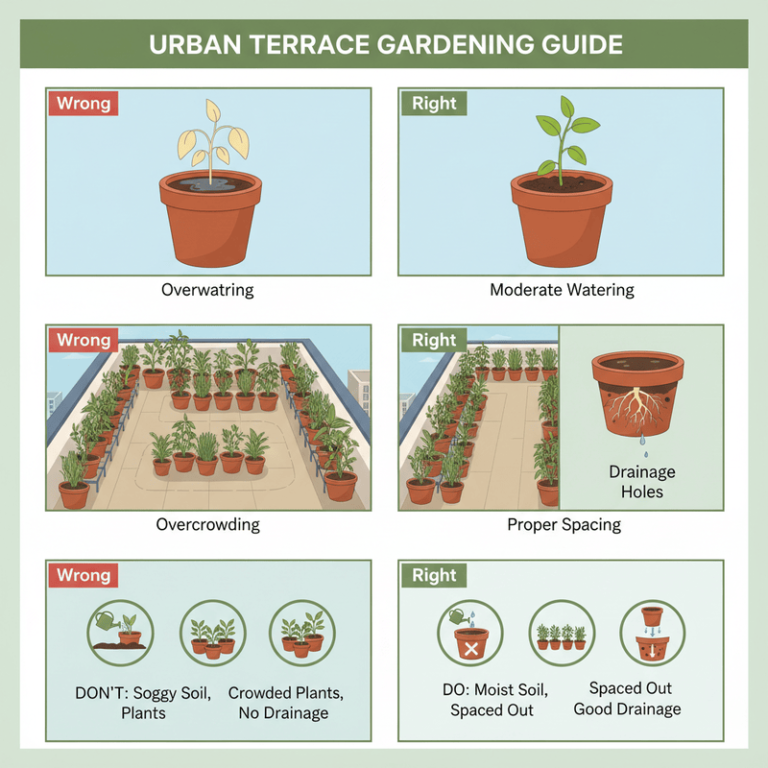
Get these basics right, and your terrace garden will feel natural and easy. Just the way it should be. The garden just… grows. Plants thrive. You water, harvest, and enjoy.
Common Mistakes to Avoid
Most problems in the terrace garden are not a matter of luck; they are mistakes that the same first-timers make repeatedly.
Here is what confuses people, and how you can avoid the learning curve.
- Overwatering (The #1 Killer): More plants die from too much water than too little. Dig your finger two inches into the ground. Don’t water it if it’s wet.
- Skipping Waterproofing Checks (The Expensive Regret): You set up a beautiful garden. Three months later, your ceiling downstairs has water stains.
- Poor Drainage (Silent Garden Killer): Water pools in containers. Soil stays soggy. Roots rot slowly. Every single container needs drainage holes at the bottom. Elevate pots slightly using bricks or pot feet so excess water escapes freely.
- Trying to Grow Too Much at Once (Burnout Guarantee): You’re excited. You buy 50 plants, fill the entire terrace, and commit to a garden that needs 2 hours daily. Start with 10-15 plants maximum.
Is Terrace Gardening Worth It?
Yes, for most homes in Hyderabad, definitely without a doubt.
Beyond just the food and greenery, there’s something else you’ll notice, your home actually feels more comfortable.The bare concrete soaks up heat all day and radiates it back at night. Your terrace becomes a hot plate sitting on top of your house.
But when you cover that concrete with plants? The temperature drops. Studies show planted rooftops can be 5–7°C cooler than bare ones.(Source: ScienceDirect) Here’s the surprising part: if the setup is done right from the start, maintaining a terrace garden is much lighter than most people expect.
Learn how our terrace gardening services can help with layout and installation.
Want to Visualize Your Terrace Garden?
Not sure if a terrace garden will actually work on your terrace? That’s completely normal.
The easiest way to find out? A simple 2D layout plan.
We create basic terrace plans based on your exact measurements; showing where plants would go, how you’d move around, and where the watering setup would be. Even if your terrace doesn’t have a water tap, we plan around it.
Just share your terrace dimensions with us. That’s it. No commitment, no cost, just a clear picture of what’s possible before you invest any time or money.

Frequently Asked Questions About Terrace Gardening Setup in Hyderabad
1. Terrace garden setup cost in Hyderabad
For most homes in Hyderabad, the cost of setting up a terrace garden depends on the size of the terrace, the type of containers used, and the plants you choose. Small terraces can start with a simple, budget-friendly setup, while larger terraces are usually planned in phases so homeowners can expand gradually without heavy upfront investment.
2. Can I start a terrace garden without a water tap on the terrace?
Yes. Many terrace gardens in Hyderabad work perfectly without a direct water tap. With proper planning, water-efficient methods like drip irrigation, mulching, and stored water usage can keep plants healthy without daily manual watering
3. Which plants grow best in a Hyderabad terrace garden?
Hyderabad’s climate supports a wide range of plants. Vegetables like tomato, chilli, brinjal, and okra grow well, along with leafy greens such as spinach and amaranthus. Herbs like coriander, mint, curry leaves, and tulsi are also ideal for home terrace gardens.
4. Is terrace gardening difficult to maintain for working families?
Not at all. A well-designed home terrace garden is meant to be low-maintenance and fit into daily routines. Most homeowners spend just a few minutes a day on basic care once the garden is set up properly.
Want to visualize how a terrace garden fits your space? A simple 2D layout based on your terrace measurements can help you plan with clarity. Click here to share your terrace dimensions.

At Venonto, we design, install, and maintain modern urban farms with hydroponic and terrace gardens for homes and businesses. Our customized setups use food-safe materials, smart irrigation, and low-water methods to grow healthy produce with minimal environmental impact. We’re on a mission to make fresh, home-grown food practical in every Indian city.
Let’s Grow Together
Registered Office
Venonto Private Limited.
#204, 17-98/12, Sri Sai Nivas, Kamalanagar, Dilsukhnagar, Hyderabad – 500060, Telangana, India.
Phone: +91 8976402918
Email: connect@venonto.com
CIN No: U51909TG2021PTC154670
© 2026 Venonto. All Rights Reserved.